


The Glenn Dale Hospital is located at 5201 Glenn Dale Road, in Glenn Dale; it straddles the east and west side of Glenn Dale Road, north of Annapolis Road (MD 450).
The +/-206-acre property includes approximately 140 acres of forest with streams that drain to Lottsford Branch and Folly Branch, and approximately 66 acres of open land that includes the existing structures, driveways, and pedestrian paths from the former hospital.
The property is the location of the former Glenn Dale Tuberculosis Hospital and Sanatorium that was owned and operated by the District of Columbia from 1934 until it closed in 1982.
The buildings were constructed between 1933 and 1960, and currently consists of 23 structures in a campus-like setting on 60 acres.
The Maryland-National Capital Park and Planning Commission (M-NCPPC) acquired the property in 1995.
In 2011, the property was added to the National Register of Historic Places (ID 70-050).
In 2014, the property was added to the Prince George’s County Register of Historic Sites and Districts.
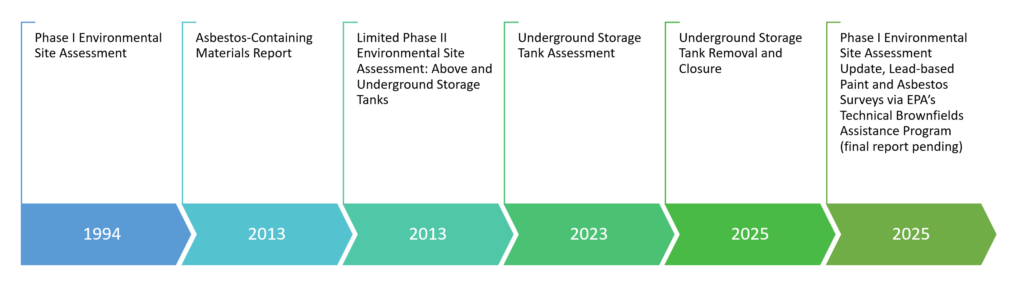
Efforts So Far
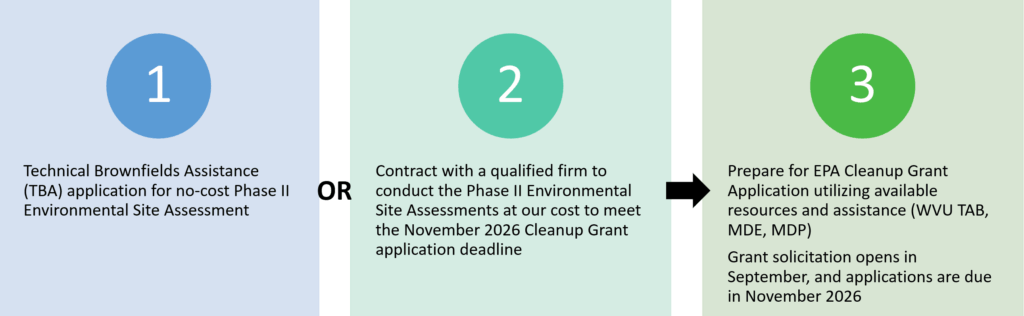
Next Steps
In 1995 the site was sold to the Maryland-National Capital Park and Planning Commission (M-NCPPC). Prior to this acquisition, the Maryland legislature passed a law at the urging of the local community mandating that any redevelopment of the 60-acre core of the former hospital site be as a Continuing Care Retirement Community (CCRC). It was also determined that the 150 acres of additional land would be reserved for park land.
While adaptive reuse of the site offered a potentially exciting economic development opportunity for Prince George’s County, past efforts to sell the site to a development entity have been unsuccessful. The primary reasons have been the market viability of the mandated CCRC use, paired with the cost for remediation and preservation of the existing historic structures.
In 2010, M-NCPPC unsuccessfully advertised for proposals to purchase the 60-acre hospital campus “as-is” with the M-NCPPC retaining around 150 acres as park land. During this time, M-NCPPC worked to designate the hospital on the National Register of Historic Places, which made tax credits available for restoration, and in 2014, Preservation Maryland placed the Glenn Dale Hospital on its list of threatened historic properties.
In 2014, a coalition was formed to pursue the redevelopment of the historic 60-acre Glenn Dale Hospital campus. Members of the coalition included Prince George’s County Council members Dannielle M. Glaros (3rd District), Todd M. Turner,(4th District), Andrea C. Harrison (5th District), several members of the Prince George’s County State House and Senate Delegations, staff from the Office of the County Executive, the Prince George’s County Redevelopment Authority, and the M-NCPPC, which owned the property.
In June 2017, under the guidance of the County’s Redevelopment Authority, a team led by The Alexander Company – a national leader in historic preservation and adaptive reuse – was selected through an RFP process to determine the feasibility of adaptively re-using the site as a CCRC. In August 2017, the Alexander Company began the feasibility study, which concluded in April 2018. The results were presented to the community in May 2018. The feasibility study found that the licensing process alone would take seven to ten years to complete. Additionally, according to the Maryland state rules on CCRS, future residents would need to put down deposits to fund the initial construction, causing them to have to wait longer than five years to start living on the site.
For these reasons, as well as a substantial funding gap, it was determined that a CCRC was not feasible, though it was clear the community still desired a senior housing component on the site. County Council members, with the support of redevelopment advocates from throughout the Glenn Dale community, worked to change the legislation mandating CCRC development. In 2019, the restriction was lifted from the deed. To that end, M-NCPPC would then pursue hiring consultants to move forward with the redevelopment of the site in another way.
With the advocacy of Preservation Maryland and the same advocates referenced above, the Maryland legislature also amended the State’s historic preservation statute to allow individual buildings to be eligible for state historic tax credits as separate projects under the $3 million “per project” cap, thus potentially increasing the amount of equity to help fund a redevelopment effort.
Following this, the planning team, led by The Alexander Company and including more than a dozen consulting firms, worked to develop concept plans that include existing context land uses, plans and accompanying densities, construction type and square footage of buildings, vehicular/pedestrian circulation, parking, open space, amenities, and infrastructure, for the redevelopment of the Glenn Dale Hospital site. To the extent possible, the re-use of the existing buildings will be incorporated into the proposed plan. The proposed plan must conform with the Secretary of the Interior’s Standards for Rehabilitation, which requires minimal change to the defining characteristics of historic buildings, their site, and environment.
The property is currently zoned O-S: Open Space, which provides for areas of low-intensity residential development. A special exception would be required for the historic adaptive re-use/planned retirement community. The steps to obtain the entitlements that would allow the site to be redeveloped, include but are not limited to:
- Detailed Site Plan and a Concept Plan that includes density, capacity, and uses
- A Preliminary Plan of Subdivision
- Traffic study
- Natural Resources Inventory
- Stormwater study
We are committed to maintaining open communications and always welcome questions and feedback. We encourage interested members of the community to stay informed by following this webpage. Please check back for the latest information on future updates as well as information about community meetings and how you can voice your opinion in the conversation.