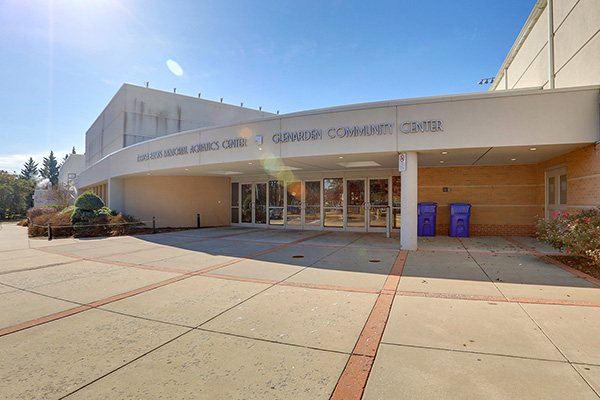
Family Changing Room

Indoor Pool
Lockers
Parking Lot
Indoor Swimming Pool

Family Changing Room
Indoor Pool
Lockers
Parking Lot
Indoor Swimming Pool
| Indoor Pool | Locker Room | Patio Area |
| Lap Lanes | Outdoor Patio | Pool |
| Showers | Spa/Hot Tub | Swimming Pool |
Prince George County aquatic facilities offer free and low-cost access to many premium recreational and fitness facilities and classes. View the current admissions and fees.
The pool rules and regulations for the M-NCPPC, Department of Parks and Recreation have been established for the benefit and protection of all aquatic facility users to ensure the safe operation of the swimming pools and to provide enjoyable recreation for all. View the current pool rules.
| Days | Facility / Building | Main Pool |
| Mondays | 6 pm-12 noon 4 pm-8:30 pm | 6 am-12 noon – Limited general swim & programs 12 noon-4 pm – Closed 4 pm-6 pm – General swim 6 pm-8:30 pm – Programs only |
| Tuesdays | 6 am-8:30 pm | 6 am-9 am – General swim 9 am-11 am – Limited General Swim & programs 11 am-5 pm – General swim 5 pm-8:30 pm – Limited General Swim & programs |
| Wednesdays | 6 am-12 noon 4 pm-8:30 pm | 6 am-12 noon – Limited general swim & programs 12 noon-4 pm – Closed 4 pm-6 pm – General swim 6 pm-8:30 pm – Programs only |
| Thursdays | 6 am-8 pm | 6 am-9 am – General swim 9 am-11 am – Limited General Swim & programs 11 am-5 pm – General swim 5 pm-8 pm – Limited General Swim & programs |
| Fridays | 6 pm-12 noon 4 pm-8:30 pm | 6 am-12 noon – Lap swim & programs 12 noon-4 pm – Closed 4 pm-8:30 pm – General swim |
| Saturdays | 7 am-5 pm | 7 am-12 noon – Programs Only 12 noon-5 pm – General swim |
| Sundays | 12 noon-5 pm | 12 noon-5 pm – General swim |
Spa is open during limited and general swim time periods
The Maryland-National Capital Park and Planning Commission, Department of Parks and Recreation, Prince George’s County has immediate openings for Lifeguards.
Looking for a fun and exciting job? Consider a position with the Prince George’s County Department of Parks and Recreation Aquatics team.
M-NCPPC offers FREE* Lifeguard Training to prospective employees. Sign up for a Lifeguard Pre-Test today for only $10. M-NCPPC even offers Lifeguard Prep Swim Lessons for those who need to improve their swimming skills to help pass the Lifeguarding Pre-Test.
*If a participant takes a Department Lifeguarding class, does not pass, does not apply and/or get hired by M-NCPPC, they will have to pay the course fees.
Applicants must be 15 years of age to work for M-NCPPC. All you need to get started is a great work attitude and a completed Aquatics Employment Application. Search online for the positions listed below for which you are qualified. Please note that not all positions are advertised year-round.
M-NCPPC offers great benefits including:
The Pool & Hot Tub Alliance® Certified Pool & Spa Operator (CPO) Certification program provides individuals with the basic knowledge, techniques, and skills of pool and spa operations. Participants must be 16 years of age in order to participate in this course, attend all course sessions and pass the final exam to be issued a CPO Certification. To view class offerings and to register, visit PARKS DIRECT.
Part 1: Pool Operator Primer Prerequisite
Part 2: Pool Operator Fusion
Candidates must be visible on webcam the entire time while taking the exam. Phones are not recommended for taking the exam because the small screen size may make it difficult to read the text questions. If necessary, the candidate may use one device for providing webcam capability (phone, tablet) while using another device to take the exam. Candidates will need to show or send the Instructor a photo identification at the beginning of the virtual classroom session. To view class offerings and to register, visit PARKS DIRECT. Please call 301-446-6896 or click here to email us if you have questions.
FREE Lifeguard Training is available for candidates who successfully complete/meet the following pre-employment requirements:
Once candidates complete/meet the pre-employment requirements, they will be assigned to an American Red Cross Lifeguarding course offered at one of our department aquatic facilities within one to two weeks of the interview.
The Department of Parks and Recreation is an American Red Cross Training Provider. To view class offerings and to register, visit PARKS DIRECT.
Interested in taking the Lifeguarding Training course, but need more practice? Register for these swim prep swim lessons that focus on stroke development and endurance and help prepare swimmers for the Lifeguard Pre-Test. To view class offerings and to register, visit PARKS DIRECT.
The purpose of the American Red Cross Lifeguarding course is to provide entry-level lifeguard participants with the knowledge and skills to prevent, recognize, and respond to aquatic emergencies and to provide care for breathing and cardiac emergencies, injuries and sudden illnesses until Emergency Medical Services (EMS) personnel take over. This course is offering as an blended learning course with interactive eLearning modules and instructor led sessions. Register for the Lifeguard Pre-Test first, once you pass the pre-test then you would register for the Lifeguard Training course. To view class offerings and to register, visit PARKS DIRECT.
This pre-test is necessary for the Lifeguard Training course (both pre-test and course must be taken at the same facility). Register for the pre-test prior to registering for Lifeguard Training, to view class offerings and to register, visit PARKS DIRECT.
Participants must be at least 16 years old and demonstrate the following:
Become certified as an American Red Cross Lifeguarding Instructor. This course teaches students to train and certify participants in Lifeguarding and CPR/AED. Participants must be currently certified in basic-level Lifeguarding/First Aid/CPR/AED.
During the Pre-course Session, you must successfully demonstrate competency in the following swimming skills evaluation and four rescue skill scenarios:
Pre-test and training courses must be taken at the same facility.
Become an American Red Cross Shallow Water Lifeguard. The primary purpose of this course is to learn the knowledge and skills needed to prevent and to respond to aquatic emergencies in shallow water up to five feet deep. Participants must have previously passed the Shallow Water Lifeguard Pre-test (both pre-test and course must be taken at the same facility). This course is for those who are interested in working at M-NCPPC’s Glenn Dale Splash Park during the summer season only.
Pre-test for Water Attendant training course-both courses must be taken at the same facility. Participants must show proof of age and demonstrate the following:
Patrons are encouraged to sign up to receive PGPARKS ALERTS/Nixle notifications for the latest updates on the status of pool operations, schedules, emergency closures, etc. To sign up for text and/or email notices, please visit PGParks Alerts.
The outdoor pools are very popular and tend to reach capacity early in the day/sessions on weekends. To ensure patrons can be admitted to the pools, advanced reservations are encouraged during the weekends. Drop-in/day of admission will remain available until the pool’s operating capacity. Discounted admission fees for the outdoor pools are available for online reservations ONLY. Drop-in/Day-of admission fees are regular price. Make your online reservations for the weekends. Residents can make online reservations up to ten days in advance and Non-Residents seven days in advance. Online reservations close at 7 pm the night prior.
Please contact the indoor pools directly to inquire about additional general swim times and program offerings.
We welcome groups to M-NCPPC aquatic facilities during the summer. Parties of ten or more visitors are considered groups; they require advance reservations at the facility of interest. Please use the 2023 Guidelines as a reference.
Please review the guidelines below to help ensure a smooth reservation process and a safe visit to our aquatic facilities:
| Age | Resident | Non-Resident |
| Adult | $3 | $4 |
| Child | $4.50 | $6 |
Free supervisor/counselor admissions will be rounded up to the nearest multiple of ten.
Adult lessons are for ages 18 and older and follow the American Red Cross curriculum as outlined below.
Adapt to the aquatic environment while developing a positive attitude and safe practices around water. Gain basic aquatic skills such as water entry and exit; breath control and submerging; arm and leg actions; floating and gliding on the front and back; and treading in chest-deep water. Due to the number of skills taught in this course, participants may need to repeat this level.
Prerequisites:
Build on fundamental aquatic skills and swimming strokes such as water entry and exit; breath control and submerging; floating and gliding on the front and back; and treading in chest-deep water. Front crawl, breaststroke, and elementary backstroke are introduced at this level. Learn the skills and concepts to stay safe in and around water and how to help during an aquatic emergency. Due to the number of skills taught in this course, participants may need to repeat this level.
Prerequisites
Build endurance and refine your front crawl, back crawl, breaststroke, and turns. Butterfly and flip turns are introduced at this level. Learn the skills and concepts to stay safe in and around water and how to help during an aquatic emergency. Due to the number of skills taught in this course, participants may need to repeat this level.
Prerequisites
Refine the six strokes, turns, and build endurance. Learn the skills and concepts to stay safe in and around water and how to help during an aquatic emergency. Due to the number of skills taught in this course, participants may need to repeat this level.
Prerequisites
American Red Cross Parent and Child Aquatics are designed to familiarize children with water and teach swimming readiness. In addition, these courses provide safety information for parents/caregivers and teach techniques they can use to help orient their children to the water.
A caregiver (at least 16 years of age) responsible for the learner in appropriate swimming attire must be in the water to assist and support the entire lesson.
Bubblers 1 (Parent and Child Aquatics Level 1)
Build a healthy relationship with the water, your child, and other families in this protected culture of learners! This level familiarizes parents and children with the water and teaches swimming readiness skills such as becoming comfortable in the water, support techniques and beginning breath control. This level also provides safety information for parents and teaches techniques parents can use to orient their children to the water. A caregiver (at least 16 years of age) responsible for the learner in appropriate swimming attire must be in the water to assist and support the entire lesson.
Note: Due to the number of skills taught in this course, participants may need to repeat this level.
Bubblers 2 (Parent and Child Aquatics Level 2)
Increase aquatic skill development, and self-confidence, and make fitness fun with your family! This level builds on skills learned in Bubblers 1. Parents/caregivers and young children will continue to work on basic skills including water adjustment, support techniques, and breath control. Skills such as floating and kicking on front and back are explored. A caregiver (at least 16 years of age) responsible for the learner in appropriate swimming attire must be in the water to assist and support for the entire lesson. If a child who successfully completes this level are at least three years old, they may be ready to enroll in Bobbers (Preschool Aquatics Level 1)
Note: Due to the number of skills taught in this course, participants may need to repeat this level or until they are old enough for Bobbers.
Bobbers (Preschool Aquatics Level 1)
Swimmers are familiarized to the aquatic environment and helps them acquire basic aquatic skills such as water entry and exit; breath control and submerging; floating/gliding on the front and back; and treading in chest-deep water. Arm and leg actions are also introduced at this level. Swimmers begin to develop positive attitudes and safe practices around water. Due to the number of skills taught in this course, participants may need to repeat this level.
Bobbers Exit Skills Assessment:
All Bobbers exit skills can be performed with support.
1. Enter independently, using either the ramp, steps or side, travel at least five yards, submerge to mouth and blow bubbles for at least three seconds, then safely exit the water. (Children can walk, move along the gutter or “swim.”)
2. While in shallow water, glide on front for at least two body lengths, then roll to back and float on back for three seconds, then recover to a vertical position.
Floaters (Preschool Aquatics Level 2)
Swimmers build on basic swimming skills learned in the Bobbers Series including breath control and submerging; swimming using combined arm and leg actions on the front and back; and treading in shoulder-deep water. Due to the number of skills taught in this course, participants may need to repeat this level.
Floaters Exit Skills Assessment:
All Floaters exit skills can be performed with assistance.
Strokers 1 (Preschool Aquatics Level 3)
Swimmers build on the skills learned in the Bobbers and Floaters levels, with a greater emphasis on swimming on the front and back without assistance and for longer distances. Treading in shoulder-deep water for longer periods of time will also be explored. Water safety concepts are reinforced in this level. Due to the number of skills taught in this course, participants may need to repeat this level.
Strokers 1 Exit Skills Assessment:
All Strokers 1 exit skills are done independently (defined as no adult contact, intervention or use of flotation devices).
Strokers 2 (Learn-to-Swim Level 3)
Swimmers will focus on stroke development including front crawl and elementary backstroke. Swimmers will be introduced to the scissors and dolphin kicks and will build on the fundamentals of treading water. Diving skills may also be introduced. Participants may also learn rules for headfirst entries and begin to learn to enter the water headfirst from a seated position at the poolside (if the water is at least nine feet deep where the lessons are taught). Participants who successfully complete this level and who meet the appropriate age requirement may register for Youth 4. This course may be repeated until the child is old enough for Youth Level 4.
Strokers 2 Exit Skills Assessment:
Lessons focus on building endurance, stroke, and turn refinement. Participants in this course will be expected to swim longer distances using front crawl, back crawl, butterfly, elementary backstroke, breaststroke, and sidestroke. Participants will also learn to utilize equipment such as pull buoys, fins, paddles, and/or a pace clock. Using swimming as part of personal water fitness will also be discussed. To improve strength and endurance, this course may be repeated.
Prerequisite
Youth lessons are for ages six to twelve years and Teen lessons are for ages 13 to 17.
Level 1: Introduction to Water Skills
Adapt to the aquatic environment while developing a positive attitude and safe practices around water. Gain basic aquatic skills such as water entry and exit; breath control and submerging; arm and leg actions; floating and gliding on the front and back; and treading in chest-deep water. Learn-to-Swim Level 1 skills overlap with the Preschool Bobbers and Floaters skills. Due to the number of skills taught in this course, participants may need to repeat this level.
Exit Skills Assessment:
When children complete Learn-to-Swim Level 1, they should be comfortable getting in and moving through the water and be willing to put their face in the water. Children should also be able to use arm and leg movements with assistance.
Level 2: Fundamental Aquatic Skills
Build on the fundamental aquatic skills learned in Level 1. This level marks the beginning of true locomotion skills. Participants learn to glide and float without support and recover to a vertical position. Participants further develop simultaneous and alternating arm and leg actions on the front and back, laying the foundation for future strokes. New water safety topics are introduced and previously acquired water safety knowledge and skills are reinforced. Many of the skills taught in this level are the same skills taught in Preschool Strokers 1. Due to the number of skills taught in this course, participants may need to repeat this level.
Exit Skills Assessment:
When participants complete Learn-to-Swim Level 2, they should be increasingly confident in the water. Participants are starting to swim independently using arm and leg movements, but may still need assistance when taking a breath. All Learn-to-Swim Level 2 exit skills are performed independently:
Level 3: Stroke Development
Swimmers must successfully complete Level 2 as a prerequisite. Focus on expanding the proficiency of previously learned skills by providing additional guided practice. Participants learn and practice survival floating and learn to swim front crawl and elementary backstroke at rudimentary proficiency levels. You introduce the scissors and dolphin kicks and extend the time duration for treading water. Participants also learn rules for headfirst entries and begin to learn to enter the water headfirst from a seated position at poolside (if the water is nine feet deep where the lessons are taught). As in all levels, new and previously addressed, water safety topics are included. Participants who successfully complete Level 3 have achieved basic water competency in a pool environment. Many of the skills taught in this level are the same skills taught in Preschool Strokers 2. Due to the number of skills taught in this course, participants may need to repeat this level.
Exit Skills Assessment:
When participants complete Learn-to-Swim Level 3, they have achieved basic water competency in a pool environment. They are starting to show stroke proficiency in the front crawl and elementary backstroke. They have begun learning the breaststroke and the scissors kicks and can tread water for one minute. They demonstrate comfort in deep water and maybe able to enter the water headfirst from both the sitting and the kneeling positions (If the water is at least nine feet deep where the lessons are taught).
Level 4: Stroke Improvement
Swimmers must successfully complete Level 3 as a prerequisite. Focus on improvement of aquatic skills and increase endurance by swimming the strokes learned in Level 3 (i.e., front crawl, elementary backstroke) for greater distances and with more advanced proficiency. Participants add arm actions to the previously learned scissors kick and breaststroke kick to perform the rudimentary sidestroke and to learn the breaststroke. Participants also begin to learn the back crawl and butterfly, as well as the basics of performing a simple open turn at a wall. Explore diving skills. Participants learn to enter the water headfirst from a compact and stride position at poolside (if the water is at least nine feet deep where the lessons are taught). Due to the number of skills taught in this course, participants may need to repeat this level.
Exit Skills Assessment:
When participants complete Learn-to-Swim Level 4, they are starting to demonstrate effective and efficient strokes in the front crawl and elementary backstroke. They are starting to show stroke proficiency in the breaststroke, back crawl, butterfly and sidestroke. They can enter the water headfirst from both compact and stride positions (If the water is at least nine feet deep where the lessons are taught).
Level 5: Stroke Refinement
Swimmers must successfully complete Level 4 as a prerequisite. Focus on stroke refinement and increase the distance that they will swim for all six strokes: front crawl, breaststroke, butterfly, back crawl, elementary backstroke, and sidestroke. Participants will work on surface dives, flip turns and explore diving skills (if the water is at least 9 feet deep where the lessons are taught). Due to the number of skills taught in this course, participants may need to repeat this level.
Exit Skills Assessment:
When participants complete Learn-to-Swim Level 5, they are starting to demonstrate effectiveness and efficiency in all strokes. They are starting to work on endurance through longer swims that require using open and flip turns. They can enter the water using the shallow-angle dive (if the water is at least nine feet deep where the lessons are taught) and can then continue swimming.
Level 6: Swimming and Skills Proficiency-Personal Water Safety
Swimmers must successfully complete Level 5 as a prerequisite. Focus on stroke refinement to develop greater efficiency, power and smoothness for longer distances. Refine the front crawl, back crawl, butterfly, elementary backstroke, breaststroke and sidestroke. There will also be extensive work on turns and water safety skills. Due to the number of skills taught in this course, participants may need to repeat this level.
Exit Skills Assessment:
When participants complete Learn-to-Swim Level 6, they are able to swim all strokes effectively and efficiently. They are able to swim continuously while using the appropriate turns for the stroke. They also have a solid understanding about how to be safe in, on and around the water.
Take advantage of the therapeutic benefits of our expanded adapted aquatic program offerings. Are you seeking to learn new skills, enhance your abilities, accomplish the seemingly impossible, or just have fun? Adapted Aquatic programs allow individuals with disabilities the opportunity to live more, play more with the use of adaptive equipment and specialized instruction.
The following facilities offer aquatic programs for people with disabilities.
Individualized Swimming Lessons are designed for children and adults with disabilities who require one-on-one instruction. The duration of each scheduled lesson is 30 minutes in length. Lessons are held at various locations throughout the county. Participants at all skill levels are welcome.
The Department offers a variety of low and high-impact water fitness options for adults and seniors. Shallow and deep-water course options are available.
Some examples of the water fitness courses offered include:
Shallow Water Aerobics
A fast-paced and energy-packed exercise class aimed to improve cardiovascular function! You’ll get the added benefits of feeling refreshed, having a lighter mood, increased range of motion, sustained vitality, and building relationships with fellow exercise enthusiasts who love the water.
Deep Water Aerobics
Deep water is nature’s aquatic fitness machine making you feel pounds lighter and allowing you to achieve your health goals through a balanced workout routine. This class is perfect for those hoping to relieve stress on their joints. We’ll tone abs, thighs, glutes, and the upper body. Flotation belts may be used.
Aqua Spinning
Beat the temptation to be a couch potato with this challenging, aerobic, and anaerobic workout utilizing stationary bikes in the water with tension settings that allow you to work at your fitness level. This heart-healthy exercise strengthens and tones your hamstrings, buttocks, and inner thighs. Join our team-like, non-judgmental culture of diverse spinners while having fun moving to great tunes.
Aqua Zumba
This Latin-inspired aerobic workout is a fun, calorie-burning dance workout but done in low-impact water at the shallow end of the pool.
Aqua Fusion
Stir up your water routine by adding a mix of various aerobic fitness styles! Increase your strength level and bolster your mood through a blend of Water Aerobics, Aqua Sculpt, Aqua Tabata, and Boot Camp rolled into one class. In addition, you will use equipment designed to build your stamina and achieve a healthy lifestyle.
Aqua Arthritis
Enjoy an active, healthy lifestyle with increased flexibility, muscle strength, better posture, and balance. Whether arthritis, muscle fatigue, chronic pain, or surgery rehabilitation, you can join us for slow-moving, bounce-free exercise with lower impact on joints.
Aqua Boot Camp
Make a splash in this boot camp style approach to interval training that includes using water as a resistance tool while performing different exercises.
Aqua Sculpt
Use cardio and toning exercises to sculpt your body in a high-intensity, bounce-free workout. Held in the shallow end of the pool, there will be little to no impact on your joints using power and suspension moves for quick toning. Gain the self-confidence to look and feel your best!
Abs and Glutes
Splash your way to stronger abs and glutes! Discover how these muscle groups, when exercised properly, help you look your best while supporting your spine. You will use powerful techniques to tone and sculpt away inches. You will feel stronger, more self-confident, and be on your way to increased flexibility.
Hydro Pilates
This active course will take the pressure off your joints through the natural buoyancy of water. Build stamina as you tone and strengthen all your muscle groups. Enjoy a good, cardio workout and bond with others excited about maintaining great health.
**Please note: not all water fitness class types are offered at all the aquatic facilities. Please click here for specific course offerings, locations, and schedules.
The Department of Parks and Recreation is an American Red Cross Training Provider. To view class offerings and to register, visit PARKS DIRECT
The American Red Cross Water Safety Instructor Blended Learning course trains instructor candidates to teach swim lessons and other water safety programs through instructor lead sessions and interactive online homework assignments.
Requirements
This pre-test is necessary for both Water Safety Instructor Training courses (both pre-test and course must be taken at the same facility). Participates must be at least 16 years old and will need to demonstrate the ability to perform the following swimming skill at Youth 4/Adult 4 level proficiency:
The free Water Safety for Parents and Caregivers Online Course focuses on developing an awareness of the risks of drowning and how to minimize those risks, especially for young children. This online course teaches parents and caregivers about the concepts of the circle of drowning prevention, water competency, and the chain of drowning survival. It also provides guidance for applying water safety to common environments and situations where children are most at risk for drowning.
This free program is accessible online in English and Spanish.
The free Becoming a Water Safety Ambassador course covers fundamentals of water safety, provides an orientation to Red Cross materials to teach water safety in dryland, classroom-based setting, and offers ideas on how to implement water safety education in your community. This online course is intended for teachers as well as adult and youth leaders in the community who are committed to sharing Red Cross resources to impact drowning rates, especially in places that are most at risk for drowning.
This free program is accessible online.
The American Red Cross Safety Training for Swim Coaches program, which was developed in partnership with USA Swimming, is designed to teach those involved in competitive swimming including coaches, officials, athletic trainers, and aquatic exercise trainers, how to help:
Course Requirements
The Safety Training for Swim Coaches certification requirement can be met through a two-step process:
Course Prerequisites
To participate in the Safety Training for Swim Coaches course, participants must be at least 15 years of age on or before the final scheduled session of the course. There are no skill prerequisites to enroll in the Safety Training for Swim Coaches course. However, because there is an in-water skills session, participants must be comfortable in chest-deep water.
Certification Requirements
To receive the course completion certificate, the participant must:
Upon successful completion of the Safety Training for Swim Coaches online content and meeting the in-water skill verification requirement, participants should provide the necessary certificates and documentation as proof of course completion to their national governing body, such as USA Swimming and Y-USA.
The Prince George’s Parks and Recreation (PGPR) Sharks Swim Team is an official USA Swimming Team (PGPR-PV) within the Potomac Valley Swimming LSC. The Club Season begins in the Fall and continues throughout the Winter and Spring. The Summer Season Team competes in the Prince-Mont Swim League. Club and Summer Season swim meet competitions locations will vary across the DMV area.
Did you know African Americans are 1.5 times more likely to die from drowning than Whites? Did you know despite improvements in diversity efforts, African Americans still comprise less than five percent of competitive swimmers?
Legendary Marathon swimmer William “Bill” Shipp stepped up this year to raise funding, to ensure that Prince George’s County minorities learn how to swim and the barriers to competitive swimming are reduced.
A triple crown-winning swimmer, Bill has completed numerous open water swims. As a resident of Prince George’s County and advocate of competitive swimming for all, Mr. Shipp decided to dedicate his June 16, 20-mile DC Marathon Swim in the Potomac, from the Key Bridge to Mt. Vernon, to raising funds to support the Aquatics for All swim programs within the M-NCPPC, Department of Parks and Recreation, Prince George’s County.
This scholarship is geared toward improving the accessibility of competitive swimming for African American and Hispanic/Latino swimmers. Applications are not currently being accepted. Applications will start being accepted again in Fall 2024.
This is a one-year need-based scholarship to assist swimmers with team fees for Prince George’s Parks & Recreation (PGPR) Sharks swim team and is not guaranteed each year. Once completed applications are submitted, they will be reviewed, scholarship awards will be determined and families will be contacted regarding application status. All applicants must agree to fulfill all of the scholarship recipient expectations as listed below. This scholarship is available for PGPR Sharks school year and summer swim seasons as funding allows. Applicants must designate the season(s) they are applying for when submitting an application. This scholarship is not eligible for meet fees and equipment.
Scholarship Recipient Expectations: